

MODULE 2.1: HOW TO READ ORGANIZATIONAL STRUCTURE
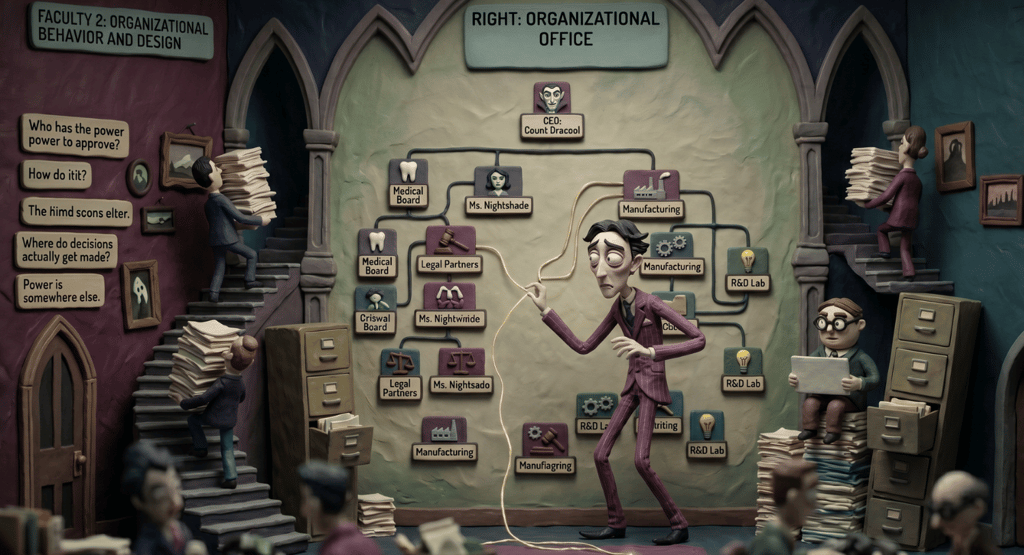
FACULTY 2: ORGANIZATIONAL BEHAVIOR AND DESIGN
COURSE 2.1: HOW TO READ ORGANIZATIONAL STRUCTURE
The test.
Look at your organization's org chart. Find your name. Then answer three questions.
Question one. Who has the power to approve something that is not in the chart? Not the CEO. The person just below them who actually says yes or no. Do you know who that is? Yes or no.
Question two. If you needed to get something done across three departments, how many approvals would you need? Count them. Do you know the number? Yes or no.
Question three. Where do decisions actually get made, not where the chart says they get made? At what level? In which meetings? By which people? Do you know? Yes or no.
Count your yes answers. That is your score out of three.
Now ask one person two levels below you: If you wanted to change one rule that slows your work down, who would you need to convince? Listen to their answer. Do not defend. Do not explain.
That is your baseline. Actual data from actual structure.
If you scored two or below, you have a measurable gap to close. If the person cannot name the decision maker, you have a structural blind spot.
You think the org chart tells you who has power. It does not. The org chart tells you who reports to whom. Power is somewhere else.
Why this matters. What Mintzberg teaches.
Henry Mintzberg spent decades studying organizational structure. He identified five configurations that every organization fits, sometimes painfully. Here is how to tell which one you are in.
Simple structure. The founder decides everything. Fast. Fragile. Works for startups. Breaks at scale. How to know you are in one: Every major decision stops at one person. That person is in every meeting. Nothing moves without them. If you need approval from the founder for something small, you are in a simple structure.
Machine bureaucracy. Rules, procedures, layers. Efficient for routine work. Terrible for innovation. Think government, manufacturing. How to know you are in one: You need approval from three people for a routine change. The approval chain is in the policy manual. No one can say yes without checking the rules first. If rules beat judgment consistently, you are in a machine bureaucracy.
Professional bureaucracy. Highly trained professionals with autonomy. Doctors in a hospital. Lawyers in a firm. Coordination happens through shared training, not rules. How to know you are in one: The people doing the work have credentials. They resist being managed. They say "I am the expert here." Decisions happen through consensus or committee. If you cannot tell who decides because the answer is "the partners" or "the medical board," you are in a professional bureaucracy.
Divisionalized form. Semi autonomous divisions by product, geography, or market. Headquarters sets targets. Divisions decide how. Works for large, diverse organizations. How to know you are in one: You have a profit and loss statement for your unit. You report numbers to headquarters but run your own operations. The real power is in the division head, not the corporate function. If you can move without corporate approval as long as you hit your numbers, you are in a divisionalized form.
Adhocracy. Project based, fluid teams, minimal hierarchy. Designed for innovation. Terrible for efficiency. Think creative agencies, R&D labs. How to know you are in one: Teams form and disband monthly. Your manager changes with each project. No one can tell you the permanent structure because there isnt one. If the org chart is obsolete the week it is printed, you are in an adhocracy.
Your organization fits one of these. The configuration tells you where power lives, how decisions get made, and how to navigate.
Failure mode. You treat your organization as if it works like a different configuration. You try to use adhocracy methods in a machine bureaucracy. You are frustrated. The organization is not wrong. Your map is wrong.
Action. Identify which configuration fits your organization. Then read the four moves through that lens.
The trigger line. Your frustration with your organization is often a mismatch between your mental model and the actual configuration.
What the model will not tell you. Some organizations are hybrids. Some are in transition. Your diagnosis may be wrong. Test it.
Now diagnose how your configuration is currently calibrated. The five configurations tell you what type of organization you are in. The five dimensions that follow tell you how that type is currently operating. Use both. Start with the configuration. Then run the diagnostic questions.
Diagnose your structure. Five questions.
Span of control. How many people report to one manager. Narrow span (3-5) means close supervision, slow decisions. Wide span (10-15) means autonomy, faster decisions, less oversight. Diagnostic: Count your manager's direct reports. If fewer than five, decisions will be slow. If more than ten, you have room to move without permission.
Centralization. Where decisions live. Top, middle, or bottom. Diagnostic: Pick a routine decision. How many layers does it go up? If more than three, you are centralized. If one, you are decentralized.
Departmentalization. How work is grouped. By function (marketing, sales, engineering). By product (Product A, Product B). By geography (North America, Europe). By customer (Enterprise, SMB). By matrix (two dimensions at once). Diagnostic: Look at the top of your org chart. The first split tells you the basis. If it splits by function, you are in a functional structure. Go to the functional leader. If it splits by product, you are in a product structure. Go to the product GM.
Organizational life cycle. Start up (simple structure, fast, chaotic). Scaling (adding process, painful). Maturity (machine bureaucracy, slow, stable). Decline (layers, politics, blame). Turnaround (back to simple structure, brutal). Diagnostic: How long has the current structure been in place? Less than two years? Scaling. More than ten? Maturity or decline.
Structural debt. Organizations accumulate workarounds, exceptions, and shadow processes that become permanent. Diagnostic: Ask five people how to get a routine approval. If you get five different answers, you have structural debt.
The trigger line. If the chart and the workflow do not match, the chart is wrong. The workflow is the real structure.
Default rule. Before you try to change anything, diagnose which configuration, which span, which centralization, which departmentalization, which life cycle stage. The intervention for a startup is the opposite of the intervention for a mature organization.
Before you begin.
You cannot change the org chart. You can learn to read it. The goal is not to redesign the company. The goal is to find the real decision makers, the real bottlenecks, and the real paths to getting things done.
The identity beneath the moves.
Amateurs look at the chart. Professionals look at the flows.
The amateur asks "who is the manager?" The professional asks "who approves the budget and who approves the exception?" The amateur assumes authority is where the boxes are. The professional knows authority is where the information stops.
The four moves.
Move one: Find the real decision maker.
Principle. The org chart shows reporting lines. Real decision makers have two things: budget authority and exception authority. The person who can spend money. The person who can say yes when the policy says no.
Counter case. In a professional bureaucracy (hospital, law firm), the real decision maker may be a committee or a senior partner with no direct reports. Budget authority and exception authority may be separate. You need both.
Failure mode. You assume the person with the title has the power. You pitch your idea to the VP. The VP says yes. Then the budget holder says no. You wasted weeks.
Action. Before any significant initiative, ask two questions. Who approves the budget for this? Who approves exceptions to standard process?
The trigger line. The org chart is a map of who reports to whom. Power is a map of who approves the exception.
Default rule. If you cannot name the budget holder and the exception approver, you do not know who the real decision maker is.
Move two: Map the real workflow.
Principle. The org chart shows boxes. Work flows across boxes. The gap between the chart and the flow is where work dies. This gap is structural debt.
Counter case. In an adhocracy, workflow is intentionally fluid. There is no single path. Mapping one workflow may not represent the next. Your diagnosis is a snapshot, not a law.
Failure mode. You design a solution based on the chart. You assume Department A sends work to Department B. In reality, Department A sends work to Department C, who waits for approval from Department B, who is waiting for data from Department A. The loop kills deadlines.
Action. Walk a single piece of work through the entire process. Write down every handoff. Count the days waiting at each handoff. Find where work stops moving.
The trigger line. Work does not flow through boxes. It flows between them. The space between boxes is where structure fails.
Default rule. If you cannot trace a piece of work from start to finish in one day, your structure has a hidden bottleneck.
Move three: Identify the information bottleneck.
Principle. Power accumulates where information stops. The person who has information no one else has, or who controls the flow of information to the decision maker, has power regardless of title.
Counter case. In a simple structure startup, the founder has all the information. The bottleneck is the founder. There is no hidden power. Your job is to work with the founder directly.
Failure mode. You go to the decision maker. The decision maker says "I need to check with my analyst." The analyst has power you did not see. You wasted the meeting.
Action. Ask: Who prepares the materials for the decision meeting? Who does the decision maker ask for a second opinion? Who hears about problems before the decision maker does?
Example. A chief of staff rewrites every presentation before it reaches the CEO. The CEO never sees raw data. The chief of staff decides what the CEO sees. That person has power. You do not need to convince the CEO. You need to convince the chief of staff.
The trigger line. Information is power. The person who controls the flow of information to the decision maker makes the decision.
Default rule. If you have not met the analyst, the assistant, and the person who runs the weekly reporting meeting, you have not mapped the power structure.
Move four: Test your assumption with a no.
Principle. The only way to know who has power is to ask for something and be told no. The person who says no and means it has power. The person whose no can be overruled has less power than you think.
Counter case. In a machine bureaucracy, the no may come from a policy, not a person. The person enforcing the policy may have no discretion. The policy is the decision maker. You cannot convince a policy.
Failure mode. You assume someone has authority. You work through them. They say yes. Then their boss changes the answer. You never knew the boss was involved.
Action. Ask for something that should be approved but is not cleanly within policy. See who says no. See whose no stands. See whose yes requires another signature.
Example. Ask for a small budget transfer that is technically against policy but obviously reasonable. The person who says no and cannot be overruled is the real decision maker.
The trigger line. A yes is only as valuable as the no that cannot be overruled.
Default rule. If you have never been told no by someone you did not expect, you do not understand your org structure.
The failure story that matters.
A product manager needed approval to launch a feature. The org chart showed the VP of Product as the decision maker. The product manager spent weeks building the case, presenting to the VP, getting a yes.
The VP's yes meant nothing. The CFO had budget authority for the launch. The product manager never talked to the CFO. The feature launched underfunded. Failed.
The product manager went back to the VP. The VP said: "I told you yes. But I do not control the budget. You never asked who holds the money."
The product manager learned. Next time, before building any case, he asked two questions. Who approves the budget? Who approves exceptions? The launch after that succeeded. The budget holder was in the room from the beginning.
The product manager later said: "I blamed the VP for six months. The VP was not the problem. I never asked the right question."
The success story that matters.
A director at a large company needed to change a procurement rule. The rule added two weeks to every purchase. The org chart showed the Procurement Director as the decision maker. The director scheduled a meeting.
An assistant pulled her aside. "Do not waste your time on Procurement. The real decision maker is the Finance Operations Manager. Procurement implements whatever Finance approves."
The director met with the Finance Operations Manager. The change was approved in one conversation. The procurement rule changed.
The assistant later said: "Everyone goes to Procurement. No one ever goes to Finance. The rule has been broken for seven years. You are the first person who asked the right question."
The director learned: the org chart shows who is responsible. Power flows through whoever can say no to the responsible person.
When to use these checkpoints.
Use the full four moves when you cannot get things done. When approvals take weeks. When your work gets blocked by people you never meet. When you keep convincing the same person and nothing changes.
For routine work, the chart is fine. For anything that requires exception, the chart is useless. Map the real structure.
Boundary condition. These moves assume there is a structure to read. In a true flat organization with no hierarchy, different rules apply. In a startup with three people, ask the founder. In a mature organization with 5000 people, map the flows.
If you cannot use these moves because every decision is made by one person at the top, you are not in a structure problem. You are in a centralization problem. See Course 2.3.
The four week system.
Week one: Find the real decision maker. Before any initiative, write down the budget holder and the exception approver. Ask someone if you are right.
Reflection question. How many people did you assume had power who actually did not?
Warning sign. If you cannot name both, stop. You are not ready to proceed.
Week two: Map the real workflow. Trace one piece of work through the entire process. Write down every handoff. Count waiting days.
Reflection question. Where did work stop moving? Who was the bottleneck?
Warning sign. If the waiting days are longer than the working days, your structure is the problem, not the people.
Mid course checkpoint. Ask the same three questions from the opening test. Compare to baseline. Improved even slightly? The system is working.
Week three: Identify the information bottleneck. Ask who prepares decision materials. Who gives second opinions. Who hears problems first.
Reflection question. Who did you not know was powerful?
Warning sign. If you have not met the analyst, the assistant, and the reporting lead, you have not mapped power.
Week four: Test your assumption with a no. Ask for something that should be approved but is not cleanly within policy. See whose no stands.
Reflection question. Whose no surprised you?
Warning sign. If you have never been told no by someone you did not expect, you do not understand your org structure.
Failure reflection loop. Write down one time you convinced the wrong person. One time work died in the handoff. One time you never met the real decision maker. One time you misdiagnosed your organization's configuration. That is your next adjustment.
The measure that matters. Watch how quickly you can identify the real decision maker for a new initiative. Speed of structural diagnosis is the only metric that matters.
What you have already done.
You completed the test. You asked someone two levels below who holds power. You discovered at least one gap between the chart and reality. That is not failure. That is data you did not have before.
The loop.
Find the real decision maker. Map the real workflow. Identify the information bottleneck. Test with a no.
The final verdict.
Careers stall on org charts. Progress happens off them.