
MODULE 2.2: DIAGNOSING ORGANIZATIONAL CULTURE
FACULTY 2: ORGANIZATIONAL BEHAVIOR AND DESIGN
COURSE 2.2: DIAGNOSING ORGANIZATIONAL CULTURE
The test.
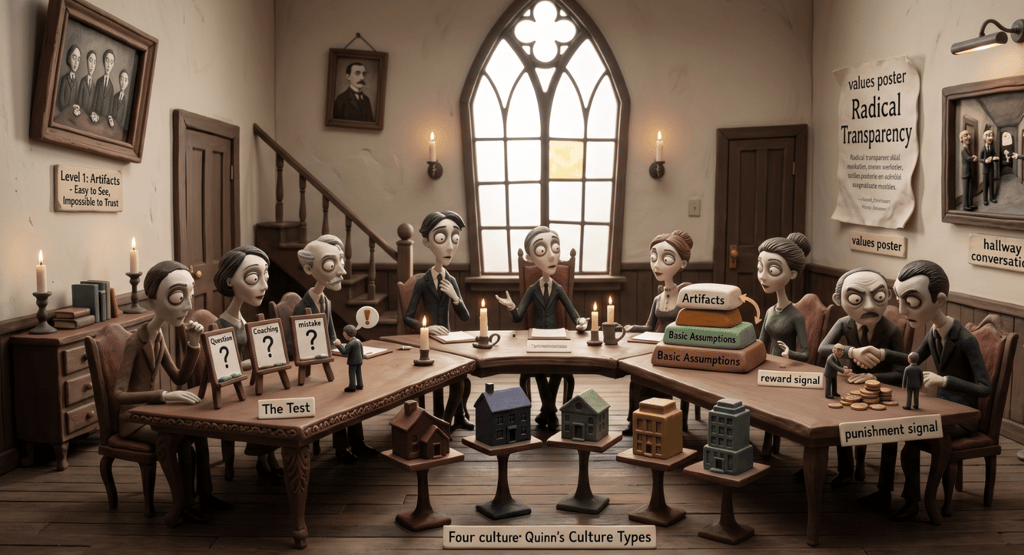
Look at your organization. Do not look at the values poster on the wall. Look at what people actually do. Answer three questions.
Question one. What happens to someone who makes a mistake? Do they get coached, hidden, or fired? Answer honestly.
Question two. Who gets promoted? The person who delivers results no matter what, or the person who fits in and follows the process? Answer honestly.
Question three. What do people talk about in the hallway when no leader is present? The numbers? The politics? The weekend? The customer? Answer honestly.
Now ask one person who joined in the last six months: What surprised you most about how things actually work here? Listen to their answer. Do not defend. Do not explain.
That is your baseline. Actual data from actual culture.
You think culture is about values. It is not. Culture is what people do when they think no one is watching.
Why this matters. What Schein teaches.
Edgar Schein spent decades studying organizational culture. Culture has three levels. Only one is visible.
Level one: Artifacts. What you see. The office layout. The dress code. The posters on the wall. Artifacts are easy to see and impossible to trust.
Level two: Espoused values. What people say they believe. The mission statement. The CEO's town hall speech. Espoused values are what the organization wants to believe about itself. They are not the same as actual values.
Level three: Basic assumptions. What people actually believe, deep enough that they do not question them. These are never written down. "Here, we ship no matter what." "Here, we never question the boss." Basic assumptions drive behavior. They are the real culture.
Failure mode. You believe the poster. You trust the town hall speech. You are confused when behavior does not match. The organization is not lying. You were looking at the wrong level.
The trigger line. Culture is not what you say. It is what you do when you think no one is watching.
Culture vs. climate. Climate is how people feel day to day. Climate changes with leadership and events. Culture is the deeper assumptions that persist. Climate is the weather. Culture is the season. You cannot change culture by changing how people feel. You have to change what they assume.
The four culture types. What Cameron and Quinn teach.
Your Mintzberg configuration from Course 2.1 often predicts your dominant culture type here. The Competing Values Framework identifies four types.
Clan culture. Internal focus, flexible. Like a family. How to know you are in one: People ask about your weekend. They know your name. They cover for you when you make a mistake.
Adhocracy culture. External focus, flexible. Innovative, risk taking. How to know you are in one: People are encouraged to experiment. Failure is discussed openly. The most interesting person is the one who tried something new.
Market culture. External focus, controlled. Results driven, competitive. How to know you are in one: The numbers are everywhere. The question is always "did you hit your number?" The person with the best results gets promoted.
Hierarchy culture. Internal focus, controlled. Structured, process driven. How to know you are in one: There is a process for everything. Promotion comes from seniority or rule following.
The trigger line. If you are frustrated by your culture, you are probably behaving as if you are in a different type. Adapt to the culture you have, not the one you wish you had.
Before you begin.
You cannot change the whole culture. You can learn to read it. The goal is not to transform the organization. The goal is
The identity beneath the moves.
Amateurs believe the poster. Professionals watch the hallway.
The amateur asks "what are our values?" The professional asks "what happens when someone breaks the rules?"
The four moves.
Move one: Find the real reward signal.
Principle. The real culture is revealed by who gets promoted, who gets celebrated, and whose opinion carries weight. Not what the criteria say. Who actually moves up.
Counter case. In a professional bureaucracy, promotion may be based on tenure or credentials. The reward signal is different. Read it correctly.
Failure mode. You believe the stated criteria. You work on the wrong things. You are passed over. You blame politics. The system was not hiding. You were not watching.
Action. Look at the last three people promoted in your area. What did they have in common? Results? Relationships? Rule following? That is your real reward signal.
Diagnostic question. What is rewarded? Who gets promoted? Who gets celebrated? Whose opinion carries weight?
The trigger line. Promotion criteria are what you put in the handbook. The last three promoted are what you actually reward.
Default rule. If you cannot name three things the last three promoted had in common, you do not know what your culture rewards.
Move two: Find the real punishment signal.
Principle. What gets people in trouble reveals the culture's boundaries. Not the policy. What actually happens to someone who makes a mistake.
Counter case. In a clan culture, punishment may be social. Exclusion from lunch. Silence in meetings. The punishment is still real.
Failure mode. You assume the policy tells you what is punished. You break a rule that was not enforced before. You are surprised.
Action. Think of the last three people who made a significant mistake. What happened to them? Coached? Hidden? Fired? That is your real punishment signal.
Diagnostic question. What is punished? What gets people in trouble? Missing a number? Breaking a rule? Speaking up?
The trigger line. The policy tells you what is punishable. What actually happens tells you what is punished.
Default rule. If you cannot predict what would happen to someone who made an honest mistake, you do not understand your culture's boundaries.
Move three: Map the subcultures.
Principle. Every organization has subcultures. Different functions, different teams. The dominant culture at the top may not be the culture where you work.
Counter case. In a highly centralized organization, subcultures may be weak. The dominant culture reaches everywhere.
Failure mode. You assume the whole organization has the same culture. You treat engineering like sales. You fail.
Action. Ask three people in different functions: "What is it like to work here?" Compare answers. Where do they agree? Where do they diverge?
Diagnostic question. What is ignored? What does no one talk about? The customer? The quality problem? The struggling team member? Silence is data.
The trigger line. The culture at the top is what leadership enforces. The culture in your function is what you have to navigate.
Default rule. If you have not asked someone in another function what it is like to work here, you have not mapped your subcultures.
Move four: Test a small change.
Principle. The only way to know if a cultural element is changeable is to try to change something small and watch what happens.
Counter case. In a hierarchy culture, change may be impossible without executive sponsorship. Your small change will be blocked. That is data.
Failure mode. You assume culture is fixed. You never try to change anything. You never test whether it could move.
Action. Pick one small behavior you want to change. Lead by example. Enlist one ally. Watch what happens. Does anyone follow? Does anyone push back?
Diagnostic question. What is the hallway conversation? What do people talk about when no leader is present? That is the real culture, unfiltered.
Default rule. If you have never tried to change a small cultural element, you do not know whether your culture is frozen or flexible.
The failure story that matters.
A new VP joined a company with a stated value of "radical transparency." She held open meetings. She shared bad news. She encouraged people to speak up.
People stopped speaking in her meetings. No one gave her honest feedback. She was confused.
The real culture was hierarchy. The stated value was aspirational. The actual assumption was "never question authority." She had never diagnosed the real culture before acting. She was seen as naive, not brave.
She eventually learned. She stopped trusting the poster. She started watching the hallway. She identified the real reward signal (rule following) and the real punishment signal (any deviation). She adapted her behavior. She stopped pushing for transparency and started building trust one conversation at a time. It took a year to rebuild credibility.
She later said: "I was trying to lead a culture I wished I had. I was ignoring the culture I actually had. That was not leadership. That was denial."
The success story that matters.
A director joined a company with a clan culture. People were friendly. Decisions were slow. No one wanted to disagree.
He needed to make a difficult call that would upset one person. In his previous company (market culture), he would have made the call immediately.
He asked a trusted colleague: "What happens to people who make unpopular decisions here?"
The colleague said: "They are still here. But the person they upset stops talking to them. It takes months to recover."
The director changed his approach. He spent two weeks building social capital before making the call. He made the decision face to face, not by email. He followed up repeatedly.
The decision stuck. The relationship survived.
He later said: "I almost destroyed my effectiveness in the first month. I was behaving as if I was still in my old culture. The day I learned to read the culture was the day I started actually leading."
How to onboard new people into existing culture.
Principle. New people absorb culture from what they see rewarded and punished in their first ninety days. Not from the orientation deck.
Failure mode. You assume new people will learn culture from formal training. They learn it from watching what happens to people who make mistakes.
Action. In the first week, introduce new people to three people who represent the real culture. One who succeeded. One who was punished. One who navigated carefully. Let them hear the stories.
The trigger line. Orientation teaches the values. The first mistake teaches the culture.
Default rule. If you do not intentionally teach new people the real culture, the hallway will teach them. You may not like what it teaches.
How to protect good culture during growth.
Principle. Growth dilutes culture. Not because new people are bad. Because culture is transmitted through stories, relationships, and repeated behavior. Growth breaks transmission lines.
Failure mode. You assume culture will persist because it is strong. Culture is not a force. It is a pattern. Patterns break when you add too many new people too fast.
Action. During growth, slow down hiring. Increase onboarding investment. Assign cultural mentors. Tell the same stories repeatedly. Surface the basic assumptions before they are buried.
The trigger line. Culture does not scale automatically. You have to scale it intentionally.
Default rule. If you double headcount without doubling cultural transmission mechanisms, you will not have the same culture.
When to use these checkpoints.
Use the full four moves when you are new to an organization. When you are frustrated by how things work. When you keep getting surprised.
For routine work, follow the existing culture. For anything that requires change, diagnose first.
Boundary condition. If you cannot use these moves because your organization is in chaos or crisis, culture diagnosis is not your priority. Stabilize first. See Course 9.3.
If you want to lead culture change, start with Move Four. Test a small change. See if the culture moves. That tells you whether larger change is possible.
The four phase system.
Phase One: Observe. Find the real reward signal. Look at the last three people promoted. List what they had in common.
Reflection question. Are you working on what actually gets rewarded?
Warning sign. If you cannot name three commonalities, you are flying blind.
Phase Two: Validate. Find the real punishment signal. Think of the last three people who made a mistake. What happened to them?
Reflection question. Are you avoiding the wrong things?
Warning sign. If you cannot predict the consequence of an honest mistake, you are taking unknown risk.
Mid course checkpoint. Ask the same three questions from the opening test. Compare to baseline. Improved even slightly? The system is working.
Phase Three: Map. Map the subcultures. Ask three people in different functions what it is like to work here. Compare answers.
Reflection question. Where do cultures diverge?
Warning sign. If everyone gives the same answer, you have a strong dominant culture. If answers are wildly different, you have subcultures to navigate.
Phase Four: Test. Test a small change. Pick one small behavior. Lead by example. Enlist one ally. Watch what happens.
Reflection question. Did the culture resist or adapt?
Warning sign. If you have never tried to change anything small, you do not know whether your culture is frozen or flexible.
Failure reflection loop. Write down one time you trusted the poster instead of the hallway. One time you misread what was rewarded. One time you onboarded someone without teaching the real culture. That is your next adjustment.
The measure that matters. Watch how quickly you can predict what will happen to someone who makes a mistake. Speed of cultural diagnosis is the only metric that matters.
What you have already done.
You completed the test. You asked a new hire what surprised them. You discovered at least one gap between the poster and the hallway. That is not failure. That is data you did not have before.
The loop.
Find the real reward signal. Find the real punishment signal. Map the subcultures. Test a small change.
The final verdict.
Watch the hallway. Ignore the poster. If you cannot read what is rewarded, punished, and ignored, you are not navigating culture. You are being shaped by it.