

MODULE 3.2: STRATEGIC DECISION-MAKING UNDER UNCERTAINTY
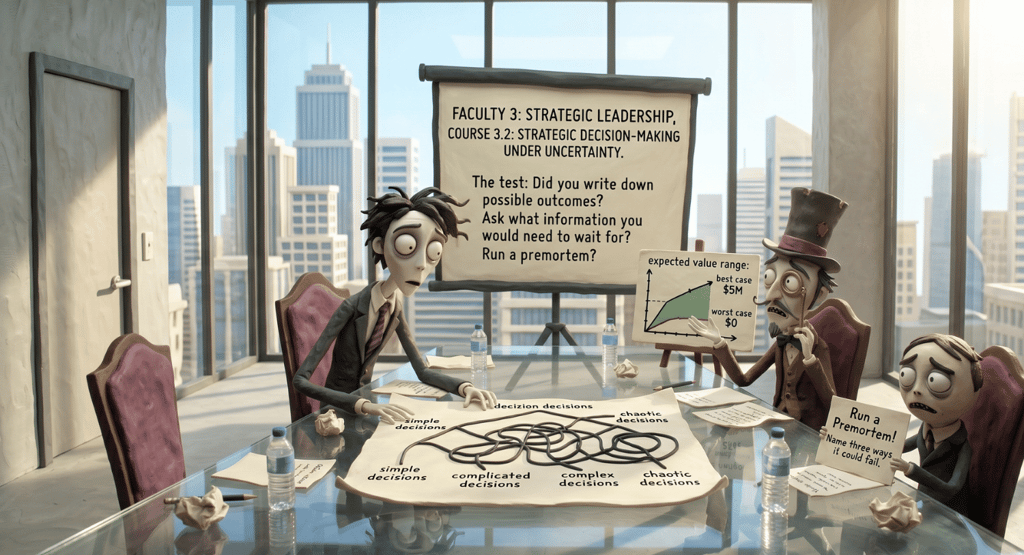
FACULTY 3: STRATEGIC LEADERSHIP
COURSE 3.2: STRATEGIC DECISION-MAKING UNDER UNCERTAINTY
The test.
Think of the last three significant decisions you made where the outcome was uncertain. Not routine choices. Decisions where you did not know what would happen next. Answer three questions.
Question one. Did you write down the possible outcomes and their probabilities? Not in your head. On paper. Yes or no.
Question two. Did you ask what information you would need to wait for before deciding, and what information would arrive too late? Yes or no.
Question three. Did you run a premortem before deciding? Not after. Before. Yes or no.
Count your yes answers. That is your score out of three.
Now ask one person on your team: In our last big decision, did you feel like we committed too early or waited too long? Listen to their answer. Do not defend. Do not explain.
That is your baseline. Actual data from actual decisions.
You think good decisions come from good analysis. They do not. Good decisions come from good process under uncertainty.
Why this matters. What the research teaches.
Herbert Simon won a Nobel Prize for demonstrating that humans do not make decisions rationally. We cannot. We have limited information, limited time, and limited cognitive capacity. That is not a flaw. It is a fact.
Rational decision-making assumes. You know all options. You know all outcomes. You know all probabilities. You can calculate the optimal choice. This never happens in real organizations.
Bounded rationality. You do not have all options. You do not know all outcomes. You cannot calculate optimally. You satisfice. You choose the first option that meets your minimum threshold. That is what humans actually do.
Failure mode. You pretend to be rational. You build elaborate spreadsheets. You calculate expected values with false precision. You make a decision. You are wrong. You blame the model. The model was fine. Your inputs were guesses.
The trigger line. Rational decision-making is what you do when you have perfect information. You never have perfect information. Learn to decide anyway.
What the model will not tell you. Satisficing works most of the time. But in high stakes decisions, satisficing is not enough. You need a process that forces you to see what you are missing.
The four decision archetypes. Know which you are facing.
Simple decisions. Known options. Known outcomes. Clear probabilities. Use a decision matrix. Decide quickly.
Complicated decisions. Known options. Unknown outcomes. Expert analysis helps. Use decision trees. Take time.
Complex decisions. Unknown options. Unknown outcomes. No expert can predict. Use premortems, red teaming, real options. Probe, sense, respond.
Chaotic decisions. Unknown options. Unknown outcomes. No time to analyze. Act first. Stabilize. Then figure out what kind of decision you are actually in.
Failure mode. You treat a complex decision as complicated. You analyze when you should probe. You wait for data that will never arrive. You miss the window.
Before you run any move, classify your decision. Simple: decide now. Complicated: map the tree. Complex: run the premortem and keep options open. Chaotic: act first. The wrong classification is the most expensive mistake you can make.
The trigger line. The first question is not what to decide. It is what kind of decision you are facing.
Default rule. If you are using the same process for every decision, you are deciding badly.
Before you begin.
You will never have enough information. That is not a problem to solve. It is a condition to manage.
The identity beneath the moves.
Amateurs wait for the window to close. Professionals know what information is worth waiting for.
The amateur waits for perfect information. The professional asks: what information would change my decision, and can I get it before the window closes?
Reversible vs irreversible decisions. The most important filter.
Reversible decisions. You can undo them. The cost of being wrong is low. Decide quickly. Learn from the outcome. Adjust.
Irreversible decisions. You cannot undo them. The cost of being wrong is high. Use the full four moves. Take time. Do not guess.
Failure mode. You treat an irreversible decision as reversible. You decide quickly. You are wrong. You cannot go back. Or you treat a reversible decision as irreversible. You analyze too long. You miss the window.
Action. Before any decision, ask: can I undo this? If yes, decide now. If no, run the four moves.
The trigger line. Reversible decisions are experiments. Irreversible decisions are bets. Know which you are making.
Default rule. If you cannot reverse the decision within a week, it is irreversible. Treat it as such.
The four moves.
Move one: Map the decision tree.
Principle. Every decision is a set of branches. Each branch has possible outcomes. Each outcome has a probability. Visualizing the tree forces you to see what you are assuming.
Counter case. In a complex decision with too many branches, mapping the tree becomes paralysis. Map the first two levels. Then stop. Use the tree to see structure, not to calculate.
Failure mode. You make decisions in your head. You do not see the branches you are ignoring. You are surprised when the branch you did not consider appears.
Action. Write down your decision as a tree. At each branch, write the outcome. At each outcome, write the probability as a range. 40-60 percent. Not 47.3 percent.
Example. A simple decision tree for a product launch: Launch now (60% chance of $10M profit, 40% chance of $2M loss). Wait six months (80% chance of $8M profit after competitor enters, 20% chance of $0 if competitor launches first). The tree shows the tradeoff clearly. The numbers are guesses. The structure is the insight.
The trigger line. If you cannot draw the tree, you do not understand the decision.
Default rule. If your tree has more than five branches, you are overcomplicating. Simplify.
Move two: Calculate the expected value range.
Principle. Expected value is probability times payoff. But probabilities are guesses. Payoffs are estimates. Do not calculate a single number. Calculate a range.
Counter case. In a high stakes decision with irreversible consequences, expected value is not enough. Ask: what is the worst case? Can I survive it? If not, expected value does not matter.
Failure mode. You calculate expected value to three decimal places. You believe the number. You ignore that your probabilities were guesses. You treat uncertainty as certainty.
Action. For each branch, calculate the best case expected value and the worst case expected value. If the range includes both positive and negative numbers, you do not have enough information to decide based on expected value alone.
Example. Launch now: expected value range is $3.8M to $6.2M. Wait: expected value range is $4M to $7M. The ranges overlap. Expected value alone does not decide. Look at worst case instead. Worst case for launch is a $2M loss. Worst case for wait is $0. Wait has better downside protection.
How to estimate probabilities under uncertainty. Use three point estimation. Ask: best case probability, worst case probability, most likely probability. Average them. Then ask: what is the reference class? How often has this happened before? Anchor on that. Then adjust.
The trigger line. A single expected value is a lie. A range is a truth.
Default rule. If your expected value range does not clearly favor one option, look at worst case. Choose the option with the least bad downside.
Move three: Run a premortem before you decide.
Principle. After the decision fails, everyone will see what went wrong. Run the premortem before you decide. Assume the decision failed spectacularly. Write down why.
Counter case. In a fast moving situation, a full premortem may take too long. Run a five minute premortem. Name three ways it could fail. Then decide.
Failure mode. You run the premortem after you have already decided. You are justifying, not testing. You ignore the failure modes.
Action. Before any significant decision, write down three ways it could fail. Then write down what you would do to prevent each one. Then ask: am I still willing to decide?
The trigger line. A premortem after the decision is a postmortem. A postmortem is too late.
Default rule. If you cannot name three ways your decision could fail, you have not thought enough.
Move four: Keep real options open.
Principle. A decision that closes off future options is different from a decision that keeps them open. When uncertainty is high, prefer decisions that preserve optionality.
Counter case. In a competitive environment, waiting preserves optionality but loses market position. The cost of optionality may be higher than the cost of committing. Calculate the tradeoff.
Failure mode. You decide too early. You commit to a path. New information arrives. You cannot change course. You are stuck.
Action. Before committing, ask: what options would I lose if I decide now? What would I gain by waiting? What information would I get by waiting? Is that information worth the cost of waiting?
The trigger line. Commitment is valuable. Optionality is valuable. Know which one you are trading away.
Default rule. If you cannot name what you would learn by waiting, decide now. If waiting would change your decision, wait.
What this looks like when you get it wrong.
A pharmaceutical company had to decide whether to continue developing a drug. Phase two trials were promising. Phase three would cost five hundred million dollars.
The team built a model. Expected value was positive. They launched phase three.
The drug failed. Five hundred million dollars lost.
The premortem would have shown: the phase two data was from a small sample. The effect size was marginal. The real risk was not the probability of failure. It was the cost of being wrong.
The team never asked "what is the worst case? Can we survive it?" They treated a bet as an investment. They lost.
The lesson: distinguish between probability of being wrong and cost of being wrong. A low probability of failure with catastrophic consequences is more dangerous than a high probability of failure with minor consequences. Calculate both.
The story that matters.
A technology company had to decide whether to acquire a smaller competitor. The price was high. The information was incomplete. The CEO was uncertain.
She ran a premortem. The team wrote down three ways the acquisition could fail. Integration problems. Culture clash. Key talent leaving.
For each failure mode, they wrote a mitigation plan. Integration team. Retention bonuses. Cultural assessment.
Then she asked: "If we wait six months, what would we learn?" The answer: whether the competitor's new product was actually working.
She proposed a smaller investment instead of a full acquisition. An option to buy. Not a commitment.
The competitor agreed. Six months later, the product was failing. The company walked away. Lost ten million instead of five hundred million.
The CEO later said: "The premortem saved me. Not because I was wrong. Because it forced me to see what I was betting on."
How to decide when to decide. Timing matters.
Principle. Deciding too early is a mistake. Deciding too late is a mistake. The optimal decision time is when the expected value of waiting equals the expected value of deciding now.
Failure mode. You wait for perfect information. It never arrives. You miss the window. Or you decide immediately. You ignore information that would have changed your decision.
Action. Before deciding, ask: what information would change my decision? How long would it take to get that information? What is the cost of waiting?
The tradeoff between speed and rigor. If you have time to run the full four moves but are tempted to decide now, ask: what disaster am I trying to outrun? If you have no time, ask: what is the cost of being wrong versus the cost of delaying? Choose the lower cost.
The trigger line. The value of waiting is the probability that new information will change your decision times the value of changing it.
Default rule. If waiting costs nothing and new information is possible, wait. If waiting costs more than the value of potential new information, decide now.
How to delegate decisions. Who should decide what.
Principle. Reversible decisions can be delegated to anyone. Irreversible decisions should be made by the person who bears the consequences. Decisions should be made at the lowest level that has the necessary information and authority. If you are making decisions that someone below you could make, you are bottlenecking. If someone below you is making decisions they do not have information for, you are abdicating.
Failure mode. You centralize all decisions. You become the bottleneck. Your team stops thinking. Or you decentralize without guardrails. Your team makes decisions without the full context. Chaos follows.
Action. For each type of decision, answer: who has the best information? Who will be affected by the outcome? Who can implement the decision? The person who answers yes to all three should decide.
The trigger line. Centralize for consistency. Decentralize for speed. Neither is always right.
Default rule. If you are making the same decision more than three times, delegate it. If you are surprised by a decision made below you, you have not set the right guardrails.
When to use these checkpoints.
Use the full four moves when the decision is high stakes, when the outcome is uncertain, or when the consequences are irreversible.
For routine decisions, trust your process. For reversible decisions, decide quickly and adjust.
Boundary condition. Some decisions cannot be improved. Only survived. Know which you are facing before you run a single calculation. If you are in a crisis, decision-making is different. Time is more valuable than analysis. Act first. Debrief later. See Course 9.2.
If you are facing a decision with no precedents and no data, you are not deciding. You are placing a bet. Name it as such.
The four phase system.
Phase One: Map the decision tree. Draw the tree for one significant decision this week.
Reflection question. What branches were you ignoring?
Warning sign. If you cannot draw the tree, you do not understand the decision.
You now see the branches. Next week you calculate what they are worth.
Phase Two: Calculate the expected value range. For the same decision, calculate the best case and worst case expected value. Use three point estimation for probabilities.
Reflection question. Does the range clearly favor one option? If not, look at worst case.
Warning sign. If the range includes both positive and negative numbers, you need more information or a different decision rule.
You now know the range. Next week you test what could break it.
Mid course checkpoint. Return to the opening test. Compare to baseline. Improved even slightly? The system is working.
Phase Three: Run a premortem. Write down three ways the decision could fail. Write down mitigation for each.
Reflection question. Are you still willing to decide?
Warning sign. If you cannot name three failure modes, you have not thought enough.
You now know where it breaks. Next week you learn to keep options open.
Phase Four: Keep real options open. Ask what you would learn by waiting. Ask what you would lose by waiting.
Reflection question. Is the information worth the wait?
Warning sign. If you cannot name what you would learn, decide now.
Failure reflection loop. Write down one time you treated a guess as a calculation. One time you committed too early. One time you waited too long. One time you skipped the premortem. One time you confused reversible and irreversible. That is your next adjustment.
The measure that matters. Watch how quickly you can name three ways your decision could fail. Speed of premortem thinking is the only metric that matters.
What you have already done.
You completed the test. You asked your team whether you committed too early or waited too long. You discovered at least one timing gap. That is not failure. That is data you did not have before.
The loop.
Map the tree. Calculate the range. Run the premortem. Keep options open.
The final verdict.
You will not have enough information. That is not a reason to delay. It is a reason to know exactly what you are betting on. Some decisions cannot be improved. Only survived. Know which you are facing before you run a single calculation.