
MODULE 5.1: BUILDING A TEAM FROM SCRATCH
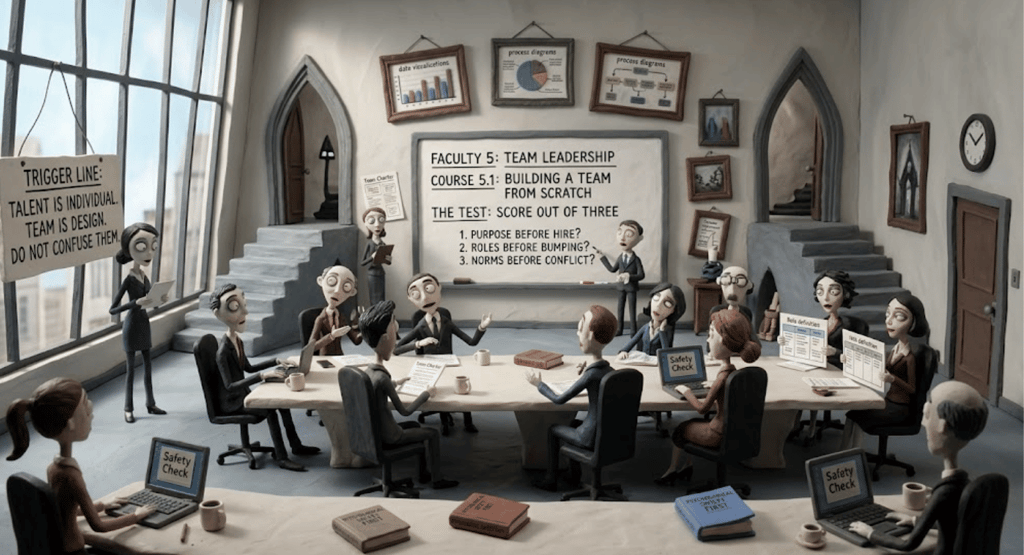
FACULTY 5: TEAM LEADERSHIP
COURSE 5.1: BUILDING A TEAM FROM SCRATCH
The test.
Think of the last team you built or joined. Not one that worked. One that struggled. Answer three questions.
Question one. Did you define the team's purpose before you hired anyone? Yes or no. Not the project goal. The reason this team exists as a team.
Question two. Did you design roles and responsibilities before people started bumping into each other? Yes or no.
Question three. Did you establish team norms before the first conflict? Yes or no.
Count your yes answers. That is your score out of three.
Now ask one person on your team: When you joined, did you know what was expected of you and what you could expect from others?
Listen to their answer. Do not defend. Do not explain.That is your baseline. Actual data from actual team building.
You think teams fail because of bad people. They do not. Teams fail because of bad design.
Why this matters. What the research teaches.
The single biggest predictor of team effectiveness is psychological safety. Not individual talent. Not clear goals. Not good process. Psychological safety comes first. Who is on the team matters less than how the team works together.
What distinguishes high-performing teams. Clear purpose. Defined roles. Shared norms. Psychological safety. The ability to surface problems without fear.
Team vs working group. A working group coordinates individual efforts. A team requires collaboration. If you do not need collaboration, do not build a team. Build a working group. It is easier to manage.
Failure mode. You hire talented people. You assume they will figure it out. They do not. They bump into each other.
The trigger line. Talent is individual. Team is design. Do not confuse them.
What the model will not tell you. You can have psychological safety and still fail if you do not have clarity. Safety without direction is not a team.
The seven steps to building a team. What most people skip.
Step one: Define purpose. Why does this team exist as a team? Not as a group of individuals. What requires collaboration rather than coordination?
Step two: Design roles. Who does what? Where do responsibilities overlap? Where are the handoffs?
Step three: Set size. Seven plus or minus two is optimal. Fewer than four, you lack diversity. More than nine, you lose cohesion.
Step four: Recruit for fit. Skill gets you in the door. Fit determines how long you stay. Fit is not culture fit. It is role fit and team fit.
Step five: Onboard with intention. The first ninety days set the pattern. Use them.
Step six: Establish norms. How we disagree. How we make decisions. How we handle mistakes. How we ask for help.
Step seven: Build safety from day one. Safety is not automatic. It is built through behavior. Model it. Reward it. Protect it.
The trigger line. Skip a step and you will pay for it later. The cost is time. The currency is trust.
Default rule. If you are not sure what step you are on, you are probably on step one again.
IF YOU REMEMBER NOTHING ELSE
Define purpose. Design roles. Recruit for fit. Set norms.
If you cannot do all four, do the first one. Define purpose.
WHERE TEAMS BREAK. WHAT SEPARATES HIGH PERFORMANCE FROM CHAOS.
The basics will get you through most team builds. The following sections address what the basics do not catch: role design, recruitment, onboarding, norms, safety, and inherited teams.
Before you begin.
You cannot build a team by accident. It requires intention at every step. Miss one and you will spend the rest of the team's life compensating.
The identity beneath the moves.
Amateurs hire talented people. Professionals design a system where talent can work. The leader designs first, hires second.
Team size. How many is too many.
Principle. Seven plus or minus two is optimal. Fewer than four, you lack diversity. More than nine, you lose cohesion. The cost of coordination increases exponentially with each new person.
Failure mode. You add people to solve a capacity problem. You create a communication problem.
Action. If you need to add people, ask: do they need to be in every meeting? If not, make them extended team members. Core team for decision-making. Extended team for input.
When to go smaller. Creative work. Fast decisions. High-stakes problem-solving. Four to five people.
When to go larger. Implementation. Execution. Projects with many dependencies. Eight to nine people.
The trigger line. Every person you add increases coordination cost. Know the tradeoff.
Default rule. If you cannot hear everyone in a meeting, your team is too large.
Team charter. The one-page agreement.
Principle. A charter is not a document. It is an agreement. Write it together. Keep it to one page.
What to include. Purpose (why we exist). Goals (what we will achieve). Roles (who does what). Norms (how we work). Meetings (when and why).
Failure mode. You write the charter. You file it. No one sees it again.
Action. Review the charter in the first team meeting. Review it quarterly. Change it when the team changes.
The trigger line. A charter is not a document. It is a contract. Renew it.
Default rule. If you cannot remember what is in your charter, you do not have one.
The four moves.
Move one: Define purpose before you hire anyone.
Principle. A team without purpose is a group of people who report to the same person. Purpose is not the goal. Purpose is why this team exists as a team rather than as individuals coordinating.
Counter case. In an emergency, build first. Define purpose as you go. Speed matters more than clarity.
Failure mode. You hire for skill. You assign tasks. People work. You think you have a team. You do not. You have a collection of individuals.
Action. Write one sentence that answers: what requires collaboration? Not coordination. Not reporting. Collaboration. If nothing requires collaboration, you do not need a team. You need a group.
The trigger line. If you cannot say why they need each other, they will not need each other.
Default rule. If you are not sure, ask yourself: would this team produce better work than the same individuals working separately? If no, you do not need a team.
Move two: Design roles before people bump.
Principle. Role ambiguity is the fastest way to create conflict. People will fill the gaps you leave. They will fill them differently. Then they will fight about who should have done what.
Counter case. In a startup, roles are fluid. That is not a bug. It is a feature of small teams. As you grow, role clarity becomes essential.
Failure mode. You assume people will figure it out. They figure it out differently. You spend months on role clarification that would have taken days up front.
Action. Write down every major responsibility. Assign one primary owner per responsibility. No more than one. Note who needs to be consulted. Who needs to be informed. Who has final approval. One primary owner per responsibility, with clear decision rights for everyone else.
The trigger line. One owner per responsibility. No exceptions. Shared ownership is no ownership.
Default rule. If two people think they own the same thing, you have not designed roles.
Move three: Recruit for role fit, not culture fit.
Principle. Culture fit is often code for "looks like us." Role fit is whether the person can and will do the work. Team fit is whether they can collaborate with the specific people on the team.
Counter case. In a team with high safety and strong norms, you can recruit for skill and trust that fit will follow. In a fragile team, recruit for fit first.
Failure mode. You hire someone who is great on paper. They clash with everyone. You blame them. You should have designed the role better.
Action. Before you interview, write down what success looks like in this role in six months. Not activities. Outcomes. Assess every candidate against those outcomes. Do not hire anyone who cannot describe the outcomes you need.
The misfit hire. What to do when you hired wrong. You will hire someone who does not fit. Do not wait. The longer you wait, the harder it gets. Have the conversation early. "This is not working. Here is why. Can we fix it?" If not, help them leave. Delay damages everyone.
The trigger line. Culture fit maintains. Role fit produces. Know the difference.
Default rule. If you cannot describe success in six months, you are not ready to hire.
Move four: Establish norms before conflict.
Principle. Norms are the unwritten rules of how we work together. If you do not set them, they will emerge anyway. They will emerge from the loudest person, the most senior person, or the most anxious person.
Counter case. In a mature team with established trust, norms can emerge productively. In a new team, set them explicitly.
Failure mode. You assume everyone knows how to disagree productively. They do not. The first conflict escalates. Trust erodes.
Action. Set norms for: how we disagree, how we make decisions, how we handle mistakes, how we ask for help, how we share credit. Write them down. Review them in the first team meeting.
The trigger line. Norms are not rules. They are agreements. Make them together.
Default rule. If you have not discussed how to disagree, you will learn how not to.
How to onboard new team members effectively.
Principle. The first ninety days set the pattern for the entire tenure.
What you do in the first week is more important than what you do in the first year.
Failure mode. You hand them a laptop. You introduce them to the team. You assume they will figure it out. They do not. They learn the wrong norms from the wrong people.
Action. Before they start, write down what they need to know in week one, week two, week three, and month two. Assign a buddy. Not their manager. Someone who will answer the small questions. Do not let them sit in silence.
The trigger line. Onboarding is not orientation. It is cultural transmission.
Default rule. If you are not sure what they need to know, ask someone who joined in the last six months.
How to create psychological safety from day one.
Principle. Psychological safety is the belief that the team is safe for interpersonal risk. It is not about being nice. It is about being able to speak up without fear of punishment or humiliation.
Failure mode. You say "mistakes are okay." You punish a mistake. People learn. They stop speaking up.
Action. Model vulnerability. Admit when you do not know. Ask for help. Celebrate people who surface problems early. When someone speaks up, thank them. When someone makes a mistake, ask "what did you learn?" not "why did you do that?"
The first time someone surfaces a problem. That moment sets the pattern for everything. If you thank them, they will bring more. If you defend or deflect, they will stop. That moment is the culture.
The trigger line. Safety is not declared. It is demonstrated.
Default rule. If people are not speaking up, you have not built safety. Assume it is your fault. Fix it.
How to lead a team you inherited.
Principle. Do not start with purpose. Start with what is working. Purpose resets can feel like criticism. Diagnose before you disrupt.
Failure mode. You assume the team is broken. You change everything. They resist. You blame them.
Action. Ask: what is working? What is not? What do you need from me? Listen for three months. Then change one thing. Then another.
The trigger line. Inherited teams do not need a hero. They need a diagnostician.
Default rule. If you have not asked what is working, you are not ready to change anything.
What this looks like when you get it wrong.
A manager was asked to build a team for a new initiative. He hired six talented people. He gave them a goal. He assumed they would figure out how to work together.
They did not. They argued about roles. They duplicated work. They missed deadlines. They blamed each other.
The manager said "I hired the best people. I gave them clear goals. I do not understand why they failed."
He skipped purpose. He skipped roles. He skipped norms. He hired talent and called it a team.
The story that matters.
A director was asked to build a team from scratch. She had six weeks before launch.
She did not hire first. She wrote a one-page charter. Purpose: "This team exists to integrate data from three systems so that leadership can see real-time metrics." Not a goal. A reason to need each other.
She designed roles. One owner per responsibility. No overlap.
She set team size. Seven people. Not eight. Not six. Seven.
She hired for role fit. She asked every candidate: "What does success look like in six months?"
She onboarded intentionally. Weekly check-ins. A buddy system. No silence.
She set norms before anyone started. "We disagree openly and commit fully. We surface problems early. We ask for help before we are stuck."
The team launched on time. They never had a major conflict. They surfaced problems early. They asked for help.
The director later said: "I spent three weeks designing before I hired one person. That time saved me six months of repair."
When to use these checkpoints.
Use the full four moves when you are building a new team, when a team is struggling, or when roles are unclear.
For existing teams, start with norms. For crisis teams, start with purpose.
Boundary condition. If you inherit an existing team, do not start with purpose. Start with what is working. Then diagnose. Purpose resets can feel like criticism.
If you are in a startup, purpose matters. Roles can wait. Speed matters more.
The four phase system. This is a summary. The full system is above.
Phase One: Define purpose. Why does this team need each other?
Phase Two: Design roles. One owner per responsibility.
Phase Three: Recruit for fit. What does success look like in six months?
Phase Four: Set norms. How we disagree. How we decide. How we recover.
The team loop. Define purpose. Design roles. Recruit for fit. Set norms.
Fallback. If you cannot do all four, do the first one. Define purpose.
The measure that matters. Watch whether people speak up when things go wrong. If they do, you have built safety. If they hide, you have not.
What you have already done.
You completed the test. You asked someone whether they knew what
was expected. You discovered at least one gap between your intent and their experience. That is data you did not have before.
The final verdict.
Teams do not fail because of bad people. They fail because of bad design. Define purpose before you hire. Design roles before people bump. Set norms before conflict. If you cannot do all three, do the first one. Define purpose. That alone will change how they work together.
YAZ GILBERT- 2026 | Powered by Writara ©