

MODULE 5.3: RESOLVING TEAM CONFLICT

FACULTY 5: TEAM LEADERSHIP
COURSE 5.3: RESOLVING TEAM CONFLICT
The test.
Think of the last three conflicts on your team. Not the ones you avoided. The ones you had to address. Answer three questions.
Question one. Did you know whether the conflict was about tasks, processes, or relationships? Yes or no.
Question two. Did you choose a resolution approach based on the situation, or did you use the same style every time? Yes or no.
Question three. Did the conflict lead to a better outcome, or did it just burn energy? Yes or no.
Count your yes answers. That is your score out of three.
Now ask one person on your team: When there is conflict on this team, do we address it or avoid it? Listen to their answer. Do not defend. Do not explain.
That is your baseline. Actual data from actual conflict.
You think conflict is a problem to eliminate. It is not. Conflict is data. The problem is not conflict. The problem is how you handle it.
Why this matters. What the research teaches.
Conflict is not inherently bad. Functional conflict improves decisions, surfaces hidden assumptions, and builds trust. Teams that engage in constructive conflict outperform teams that avoid conflict. The difference is not whether conflict happens. The difference is how you respond.
Three types of conflict.
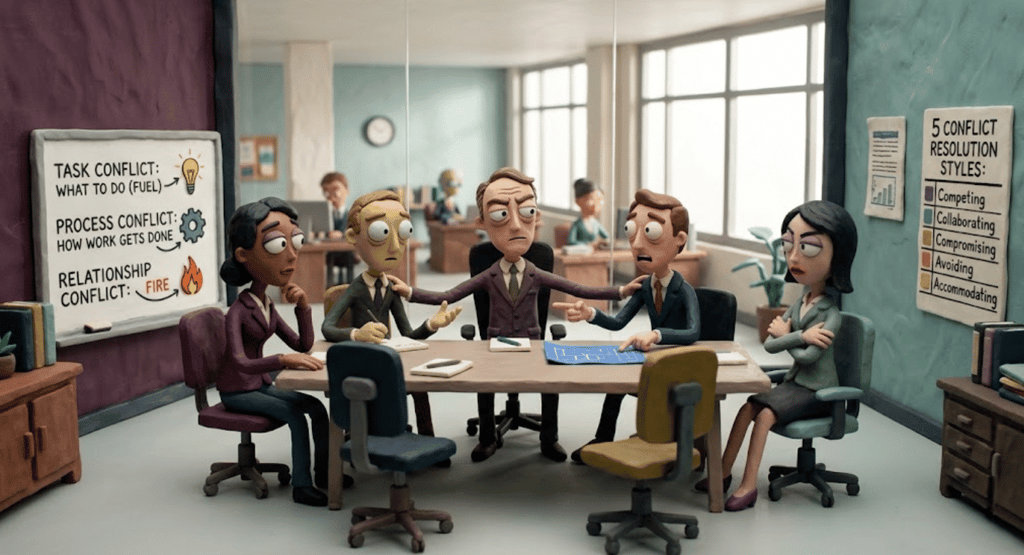
Task conflict. Disagreement about the work itself. What to do. The best approach. The right answer. This is often functional. Encourage it.
Process conflict. Disagreement about how work gets done. Who does what. Deadlines. Handoffs. This can be functional or dysfunctional. Watch for personal attacks.
Relationship conflict. Disagreement about personalities, values, or status. This is almost always dysfunctional. Address it immediately.
Functional conflict. Focused on work. Respectful. Aims for the best outcome.
Dysfunctional conflict. Focused on people. Personal. Aims to win.
Failure mode. You treat all conflict as bad. You suppress it. It goes underground. It leaks as gossip or silent sabotage.
Task conflict is fuel. Relationship conflict is fire. Know the difference.
What the model will not tell you. Some conflict cannot be resolved. Some people cannot work together. The goal is not to force peace. The goal is to know when to mediate and when to separate.
The five conflict resolution styles.
Competing. High assertiveness, low cooperation. You push your solution. Use when the issue is urgent, when you are right, or when others cannot decide.
Collaborating. High assertiveness, high cooperation. You work with the other person to find a solution that meets both needs. Use when the issue is important and you have time.
Compromising. Medium assertiveness, medium cooperation. You trade. You each give something up. Use when you need a quick solution and the stakes are moderate.
Avoiding. Low assertiveness, low cooperation. You do nothing. You hope it goes away. Use when the issue is trivial, when you need to cool down, or when the cost of addressing it is higher than the cost of ignoring it.
Accommodating. Low assertiveness, high cooperation. You give in. You let them have their way. Use when you are wrong, when the issue matters more to them, or when you are building goodwill.
How to choose the right style. Three questions.
Before you respond, ask:
How important is this issue? If very important, compete or collaborate. If not very important, accommodate or avoid.
How much time do I have? If time is short, compete or compromise. If time is available, collaborate.
What is at stake? If the relationship matters more than the outcome, accommodate. If the outcome matters more, compete.
Failure mode. You use the same style for every conflict. You compete when you should collaborate. You avoid when you should address.
Your default style is not your only style. Choose the style that fits the situation.
Default rule. If you are not sure which style to use, start with collaborating. It is the most expensive and the most durable.
IF YOU REMEMBER NOTHING ELSE
Distinguish task from process from relationship conflict. Choose the style that fits. Mediate, do not judge.
If you cannot do all three, do the first one. Distinguish the type of conflict.
WHERE CONFLICT BREAKS
The basics will get you through most conflicts. The following sections address what the basics do not catch: mediation protocol, team-wide conflict, de-escalation, repair, feedback, escalation thresholds, and irreconcilable differences.
Before you begin.
You cannot resolve conflict you do not see. If people are hiding conflict from you, the problem is not the conflict. It is psychological safety.
The identity beneath the moves.
Amateurs suppress conflict. Professionals manage it. The leader transforms conflict into information before anyone else sees it as a problem.
The four moves.
Move one: Distinguish the type of conflict.
Principle. Task conflict is fuel. Relationship conflict is fire. Process conflict is in between. Your response depends on the type.
Counter case. Some conflict starts functional and becomes personal. Intervene early. Do not let it cross the line.
Failure mode. You treat task conflict as relationship conflict. You shut down a useful debate.
Action. When conflict arises, ask: is this about what we do, how we do it, or who we are? If about what or how, encourage it. If about who, address it immediately.
Task conflict needs facilitation. Relationship conflict needs intervention.
Default rule. If you cannot tell which type it is, check for relationship signals first. Has the language become personal? Are people avoiding each other? Has trust eroded? If yes, assume relationship conflict. If no, treat it as task conflict and watch closely.
Move two: Choose the style that fits.
Principle. Your default style is not your only style.
Counter case. In a crisis, you do not have time to choose. Compete. Then repair after.
Failure mode. You collaborate on everything. It takes forever. People avoid bringing you conflict.
Action. Use the three questions: how important? how much time? what is at stake? Then choose.
The right style is the one that serves the outcome, not your comfort.
Default rule. If you are not sure, start with collaborating. You can always escalate to competing or step down to compromising.
Move three: Mediate, do not judge.
Principle. Mediation is not about deciding who is right. It is about helping them find their own resolution.
Counter case. When one person is clearly wrong, you do not need to mediate. You need to decide.
Failure mode. You decide who is right. The loser resents you. The conflict continues.
Action. Ask each person to state their perspective without interruption. Then ask: "What would resolve this for you?" Then ask the other: "What would resolve this for you?" Then ask them to find common ground.
Your opinion is not the resolution. Their agreement is.
Default rule. If you are mediating and they are still talking to you instead of each other, you are not mediating. You are refereeing.
Move four: De-escalate before you resolve.
Principle. You cannot problem-solve when people are flooded.
Counter case. In a low-stakes disagreement, skip de-escalation.
Failure mode. You try to solve the problem while they are still angry. They cannot hear you.
Action. When emotions are high, say: "I can see this is hard. Let us take five minutes." Then come back.
Calm first. Solve second.
Default rule. If they are still raising their voice, you have not de-escalated. Take more time.
How to mediate between two team members.
Step one. Meet separately. Ask: what happened? How did it affect you? What do you need?
Step two. Bring them together. State the goal: "We are here to find a way forward, not to decide who was right."
Step three. Each person states their perspective without interruption.
Step four. Ask each person: "What would resolve this for you?"
Step five. Ask them to find common ground. If they cannot, offer a suggestion. "What if we tried X?"
Step six. Agree on next steps. Write them down. Schedule a follow-up.
Mediation is not about the past. It is about the future.
Default rule. If they cannot agree after two meetings, you need to decide. Stop mediating. Start managing.
How to resolve team-wide conflict.
Principle. Team-wide conflict is different. Subgroups form. Scapegoats emerge.
Failure mode. You mediate between individuals. The team dynamic remains toxic.
Action. Call a team meeting. Name the conflict without blame. Ask each person to write down what is working and what is not. Share anonymously.
Sort the patterns into three buckets: task, process, relationship. Address relationship patterns first. Then process. Then task. Do not try to solve everything at once. Pick one pattern per meeting.
Team conflict requires team solutions. Individual mediation will not fix a broken system.
Default rule. If the same names keep coming up in anonymous feedback, the conflict is not team-wide. It is individual. Go back to the mediation protocol.
How to de-escalate heated situations.
Principle. Heat is about perceived threat. Your job is to lower threat, not win the argument.
Failure mode. You match their heat. You raise your voice.
Action. Lower your voice. Slow down. Acknowledge their emotion. "I hear that you are frustrated. I want to understand." Do not defend. Do not explain. Just listen.
You cannot de-escalate by escalating.
Default rule. If you feel your own heat rising, pause. Say "I need a moment." Take a breath. Then continue.
How to repair relationships after conflict.
Principle. Trust is repaired through action, not apology.
Failure mode. You apologize. You do nothing different.
Action. After resolution, ask: "What should I do differently next time?" Then do it. Follow up.
An apology without change is manipulation.
Default rule. If trust is not improving after three follow-ups, the conflict is not resolved. Go back to mediation.
How to give feedback about conflict behavior.
Principle. Feedback during conflict escalates. Feedback after conflict lands.
Failure mode. You tell them in the moment. They feel attacked.
Action. After the conflict is resolved, say: "When we disagree, you tend to X. That makes it harder for me to hear you. Could we try Y next time?"
Feedback about conflict behavior belongs after resolution, not during.
Default rule. If they are defensive about the feedback, the conflict is not over.
When to escalate to HR.
Principle. Some conflict is beyond your capacity. Harassment. Discrimination. Threats. Violence.
Thresholds. Repeated personal attacks after warning. Any threat of physical harm. Comments about protected categories that create a hostile environment. Pattern of exclusion or retaliation.
Failure mode. You try to handle it yourself. You expose the organization to liability.
Action. Document what you have seen and heard. Escalate to HR. Do not warn the person first.
Some conflicts are not yours to resolve. Know when to escalate.
Default rule. If you are not sure whether to escalate, escalate. Better to over-escalate than to under-react.
Irreconcilable conflict. When to stop mediating.
Principle. Some conflicts cannot be resolved. Some people cannot work together. Forcing them to collaborate will not fix the relationship. It will damage the team.
Signals. The same issue has been mediated twice with no change. They refuse to be in the same room. Each meeting ends in personal attacks. One person has asked to be transferred.
Failure mode. You keep mediating. You believe conflict can always be resolved. You waste months. You exhaust the team.
Action. Separate them. Restructure roles so they do not need to collaborate directly. If that is not possible, help one person leave. Do not wait until everyone is burned out.
Some relationships are not repairable. The best resolution is distance.
Default rule. If you have mediated twice and nothing changed, stop. You are not failing. You are recognizing reality.
What this looks like when you get it wrong.
A manager had two team members who disagreed constantly. One wanted to move fast. One wanted to be thorough. The manager told them to work it out.
They did not. They stopped talking. They hid information. Projects stalled.
The manager thought they were adults. He thought they should figure it out. They did not have the skills. He never taught them. He never mediated.
He was not managing conflict. He was avoiding it.
The story that matters.
A director had two senior leaders who were openly hostile. They argued in meetings. They undermined each other. The team was suffering.
The director met with each separately. He learned the conflict was not personal. It was about resource allocation.
He brought them together. He said: "We are not here to decide who is right. We are here to fix the resource problem."
They each named a condition. They agreed to a trial. He wrote it down.
Three months later, the conflict was gone. They were not friends. They were functional.
The director later said: "I almost decided who was right. Instead, I helped them solve the problem beneath the problem."
When to use these checkpoints.
Use the full four moves when conflict is affecting work, when people are avoiding each other, or when you hear about conflict secondhand.
For minor disagreements, trust them to resolve it. For personal attacks, intervene immediately.
Boundary condition. If the conflict involves harassment, discrimination, or abuse, do not mediate. Escalate to HR.
If one person is consistently the source of conflict, the problem is not the conflict. It is the person. See Course 5.1.
If you have mediated twice and nothing changed, stop. See irreconcilable conflict protocol.
The four phase system.
Phase One: Distinguish the type. Task, process, or relationship. Check for relationship signals first.
Phase Two: Choose the style that fits. Use the three questions: importance, time, stake.
Phase Three: Mediate, do not judge. Help them find their own resolution.
Phase Four: De-escalate before you resolve. Calm first. Solve second.
The conflict loop. Distinguish. Choose. Mediate. De-escalate.
Fallback. If you cannot do all four, do the first one. Distinguish the type of conflict.
The measure that matters. Watch whether conflicts lead to better outcomes or just burned energy. If they lead to better outcomes, you are doing it right. If they just burn energy, your approach is wrong. If the same conflict recurs after two mediations, the relationship is not repairable. Separate them.
What you have already done.
You completed the test. You asked someone whether your team addresses conflict or avoids it. You discovered at least one gap between your intent and their experience. That is data you did not have before.
The final verdict.
Conflict is not the problem. Suppression is. Distinguish task from process from relationship conflict. Check for relationship signals first. Choose the style that fits. Use the three questions: importance, time, stake. Mediate, do not judge. De-escalate before you resolve. If the same conflict recurs twice, stop mediating. Separate them. That is not failure. That is recognizing reality.
YAZ GILBERT- 2026 | Powered by Writara ©