

STOP MANAGING YOUR FEELINGS. START MANAGING YOU INTERPRETATIONS

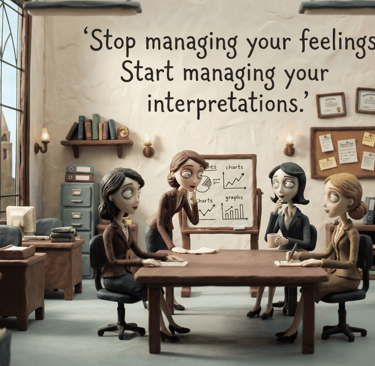
A product manager once told me her team was failing because morale was low.
I asked her to describe the last three decisions they made. She did. Each one was defensible. Each one had data behind it. Each one produced a worse outcome than expected.
Then I asked: "What if morale is not the cause? What if morale is the data?"
She sat with that for a minute. "You are saying the low morale is not the problem. It is the reading of the problem."
Yes.
Most people treat mindset as emotional management. Stay positive. Stay confident. Do not let the team see you sweat.
That is not mindset. That is performance.
Real mindset is the discipline of not knowing. Holding two interpretations at once. "We are failing because we made bad decisions" and "We are failing because the market shifted overnight." Both could be true. One is useful. The other is just punishing.
The product manager was reading low morale as a cause. That produced guilt. Guilt produces inaction. She shifted to reading low morale as a symptom. That produced curiosity. Curiosity produced a new question: "What would we do differently if we believed the market changed, not that we broke?"
The team did not suddenly become confident. They became curious. That was enough.
Here is the test. The next time something goes wrong, ask two questions.
"What is the punishing interpretation?" (We are incompetent. We should have known. Someone failed.)
"What is the useful interpretation?" (We did not have that data. The conditions shifted. Now we know something new.)
You do not have to believe the useful one. You just have to act on it and see what happens.
That is the discipline. Not positivity. Not resilience. Just the willingness to hold a useful fiction long enough to test it.
Stop managing your feelings. Start managing your interpretations. The first is exhausting. The second is a skill.