

THE COST OF SAYING IT
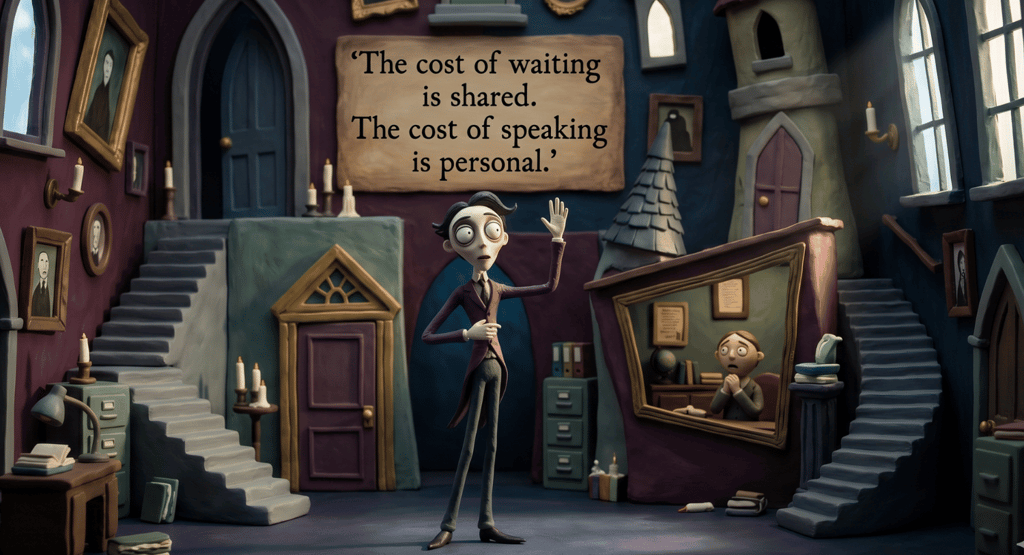
The engineering manager waited until the end of the meeting. Not because he was shy. Because he wanted to see if anyone else would say it first.
No one did.
Fifteen people in the room. A project six months behind schedule. A client who had stopped returning emails. And a VP who kept asking for updated timelines as if the problem was the accuracy of the forecast rather than the work itself.
The engineering manager raised his hand. Not a power move. Just a hand. Like he was in a classroom.
"Can I say something?"
The VP nodded.
"We all know why this project is late. It is late because we promised something we did not know how to build. We are still promising it. And we are still not any closer to knowing how to build it."
Silence. Not dramatic silence. Just the silence of people who have been caught in a lie they did not realize they were telling.
The VP did not get angry. He did not thank the engineering manager for his courage. He just sat there for a few seconds and then said, "Okay. What do we actually know how to build?"
That question changed the project. Not because it was brilliant. Because it was honest. And once the VP asked it, everyone else had permission to stop pretending.
The team cut the feature set in half. They delivered in ten weeks. The client was relieved, not angry. They had known the original promise was impossible. They were just waiting for someone on our side to admit it.
That was ten years ago. The engineering manager is a CTO now. Not because he was the smartest person in the room. Because he was willing to be the one who stopped the performance.
Every organization has a version of that meeting. The details change. The pattern does not.
Someone knows something. Everyone knows someone knows. And no one says it.
The salesperson who knows the deal is not going to close. The software developer who knows the architecture is broken. The nurse who knows the discharge protocol is unsafe. The teacher who knows the curriculum does not work. The knowledge is there. It is just not spoken.
Why not?
Because speaking it has a cost. The salesperson looks like a pessimist. The developer looks like a complainer. The nurse looks like she cannot handle pressure. The teacher looks like she is making excuses. The cost is real. The system punishes truth tellers even when the truth is useful.
So people wait. They wait for someone else to say it. They wait for permission. They wait for the problem to get so big that no one can ignore it.
By then, the cost of waiting is usually higher than the cost of speaking would have been. But that cost is shared. The cost of speaking is personal. That is why people choose silence.
What would happen if you stopped waiting?
Not in a dramatic way. Just by saying the thing you know is true in the next conversation where it matters.
The engineering manager raised his hand and asked a question. A floor manager named Carter sat on a metal stool for four hours, then moved a glove dispenser four feet to the left. Small moves. Specific moves. Moves that cost something but not everything.
Here is what those people learned. The cost of speaking is almost always lower than you imagine. The cost of silence is almost always higher. And the person who speaks first is not the bravest person in the room. They are just the person who stopped calculating.
Try this tomorrow. In a meeting where everyone is dancing around something real, ask one question.
Not "What are we pretending not to know?" That is a coaching question. Ask the real version.
"Is this actually working?"
"We have been trying this for three months. Is it working?"
"I have a concern I have not shared. Can I share it?"
That is it. Just the willingness to interrupt the performance for five seconds.
What happens next is not your responsibility. The room might thank you. The room might ignore you. The room might turn on you. You do not control that. You only control whether you speak.
The question is not whether you are a leader. The question is whether you are willing to pay the small cost of saying what is true.
The engineering manager paid it. Carter paid it. None of them thought of themselves as leaders at the time. They were just tired of pretending.
That is the only qualification that matters.