
THE LOUDEST PERSON IN THE ROOM IS RARELY THE WISEST
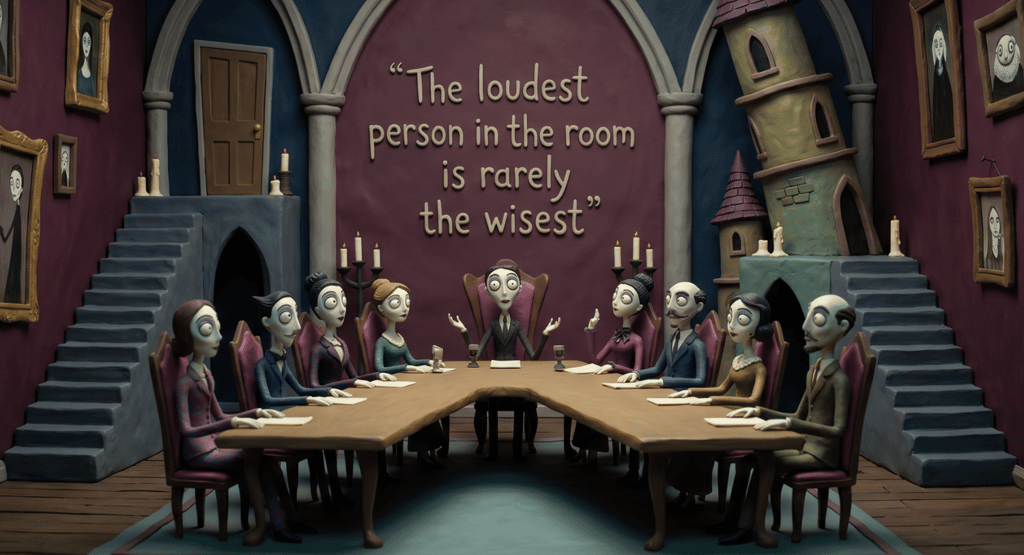
The board chair fired her CEO last week.
Not with a press release. Not with a dramatic exit memo. She stopped waiting for him to speak first.
Twelve months of "we need bold vision" meetings. Twelve months of one man talking. Twelve months of smart people staring at their shoes.
She walked into the next meeting, sat at the head of the table, and said: "I want to hear from everyone who hasn't spoken in the last year."
Twenty-seven people. I counted. Twenty-seven ideas. Three of them, roughly, saved the company. One was a pricing change. Another was a customer segment nobody had looked at. The third was permission to stop doing something stupid.
The loudest person in the room is rarely the wisest.
We spent two decades worshipping the charismatic CEO. The chest-pounding visionary. The person who could fill a room with their voice and empty it of everyone else's.
That era is fading. Quietly. Which is appropriate, I suppose.
Not silence. Not passivity. But the ability to listen before you decide, to ask before you announce, and then, this is the part I had to learn, the willingness to be wrong about which ideas are good.
One study. Google's Project Aristotle. 2015. You can look it up. They found that psychological safety was the single strongest predictor of team performance, stronger than individual talent, stronger than incentives.
Not 27 percent. Not a tidy number. Just the truth: it matters more than almost anything else.
Here is the objection: "But someone still has to make the final call."
Yes. Quiet leadership is not abdication. The quiet leader still decides, still directs, still draws the line. They do not draw it before hearing from the people who will have to walk it.
Try this tomorrow.
Walk into a meeting. Say nothing for the first ten minutes. Listen.
Watch who hesitates. Watch who checks their phone. Watch who looks at you for permission to speak.
That map of silence tells you more than any engagement survey ever will.
The best leader I ever worked for spoke last in every single meeting. Not because he was shy. Because he knew that once he opened his mouth, the thinking stopped.
He was right about that. He was wrong about plenty of other things. But he got this right.
So here is what I actually believe.
Loud leadership has a cost. The cost is other people's thinking. Sometimes that trade-off is worth it. When the building is on fire, you do not need a committee. But most days, the smartest thing you can do is shut up and find out what the people around you already know.
What have you heard recently because someone stopped talking?