

MODULE 4.1: THE FIRST 60 SECONDS OF ANY CONVERSATION
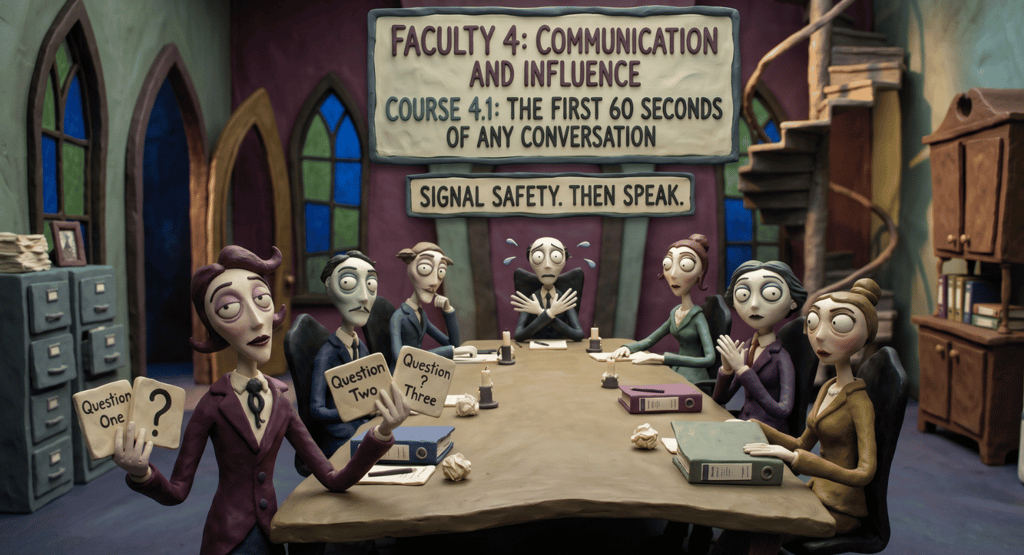

FACULTY 4: COMMUNICATION AND INFLUENCE
COURSE 4.1: THE FIRST 60 SECONDS OF ANY CONVERSATION
The test.
Think of the last three conversations that went poorly. If you cannot think of any that went poorly, think of three where the other person did not change afterward. Answer three questions.
Question one. Did you open with a statement or a question? Statement or question.
Question two. Did you name the purpose of the conversation within the first three sentences? Yes or no.
Question three. Did you consider what the other person needed to hear first, before what you needed to say? Yes or no.
Count your question-based openings, your purpose statements, and your other-centered considerations. That is your score out of three.
Now ask one person you have a difficult conversation with: In the first minute of our last hard conversation, did you feel like I was trying to understand you or convince you? Listen to their answer. Do not defend. Do not explain.
That is your baseline. Actual data from actual openings.
You think the first sixty seconds are about what you say. They are not. The first sixty seconds are about what the other person hears. By the time you have said your third sentence, they have already decided whether this conversation is safe, whether you are on their side, and whether they should listen or defend.
Most performance issues are not performance issues. They are opening issues.
Why this matters.
The primacy effect is well-established. It shapes what people remember. The first sixty seconds are not just important. They are the frame. Once the frame is set, everything that follows is interpreted through it. A bad opening is difficult to recover from.
First impressions are not about likeability. They are about threat detection. The other person's brain is asking one question in the first sixty seconds: Am I safe? Not "is this person competent?" Not "is this information useful?" Safe. If the answer is no, their listening shuts down. They are not processing your words. They are preparing their defense.
Failure mode. You open with what you need to say. You assume the other person is ready to hear it. They are not. By the time you get to your point, they have already stopped listening.
What the model will not tell you. Some people will never feel safe with you. That is not a failure of your opening. That is a signal about the relationship. If someone is committed to misunderstanding you, you are not in a communication problem. You are in a power problem. See Course 4.2.
The diagnostic. What your opener signals.
If you open with your conclusion, you signal "I have decided." The result is defensiveness. The correction: open the middle instead.
If you open with context and history, you signal "I need to justify this." The result is impatience. The correction: state purpose first.
If you open with nothing, you signal "I am uncomfortable." The result is anxiety. The correction: name the difficulty.
If you open with "We need to talk," you signal "Threat incoming." The result is shutdown. The correction: use acknowledgment opener.
The four opening archetypes.
Archetype one: The purpose opener. State why you are here within three sentences. Use this when the conversation is expected, when you have authority, or when time is short. "I asked for this meeting because I need to make a decision about X and I want your input."
Archetype two: The question opener. Ask before you tell. Use this when you are unsure of the other person's state or when you have less authority. "What is on your mind about X? I want to understand where you are before I share where I am."
Archetype three: The acknowledgment opener. Name what is hard first. Use this when the conversation is difficult or the other person is defensive. "I know this is not easy. I appreciate you making time for it."
Archetype four: The invitation opener. Ask for permission before you proceed. Use this when you are interrupting or when the other person has control over their attention. "Do you have a few minutes, or should we schedule time later?"
Failure mode. You use the wrong archetype. You open with a statement when they need acknowledgment. The conversation starts badly.
Default rule. If you do not know which archetype to use, start with acknowledgment. It is never wrong to name what is hard.
IF YOU REMEMBER NOTHING ELSE
Signal safety. Then speak.
Open with what they need, not with what you want.
State purpose within three sentences.
Name the difficulty if it is hard.
Open with uncertainty, not certainty.
If you cannot do all five, do the first one. Signal safety. Then speak.
THE ADVANCED LAYER
The basics will get you through most conversations. The following sections address what the basics do not catch: what happens before you speak, how to read their first fifteen seconds, the risk of inauthenticity, and what to do when the other person cannot be reached.
The identity beneath the moves.
The amateur rehearses their point. The professional rehearses what the other person needs to hear. The leader rehearses the frame.
The sixty seconds before you speak. When the opening really starts.
Principle. Your opening does not begin when you speak. It begins when they see you. The set of your face, the pace of your walk, the tone you carried from the last meeting. They are reading you before your first word.
Failure mode. You rehearse your opening. You ignore what you are carrying. They detect threat before you signal safety.
Action. In the sixty seconds before you speak, ask yourself one question. What am I telling myself about this person right now? If the answer is "they are wrong," "they are difficult," or "they will not listen," your opening will fail. The technique cannot override what you actually believe.
The trigger line. The technique is a structure for expressing what you believe. It is not a substitute for believing it.
Default rule. If you do not respect the other person's perspective, do not use the acknowledgment opener. It will feel like a lie. They will feel it. Use the purpose opener instead. It is more honest.
Read the first fifteen seconds. Not your opening. Their reaction.
Principle. You cannot see your own opening. You can see their reaction. In the first fifteen seconds, before you have finished your third sentence, watch them.
What to look for. Their shoulders. If they rise, they are bracing. Their eyes. If they look away, they are escaping. Their hands. If they close or cross, they are defending. The half-second before they respond. If they pause too long, they are deciding whether to engage or fight.
Failure mode. You keep talking. You do not notice the signals. They are already gone. You never adjust.
Action. In the first fifteen seconds, watch. If you see bracing, escaping, or defending, stop. Use the reset. "I think I started this badly. Let me try again."
The trigger line. The first fifteen seconds are their truth. The next forty-five are your chance to respond to it.
Default rule. If you are not watching their body in the first fifteen seconds, you are talking to yourself.
The inauthenticity risk. When technique backfires.
Principle. Skilled people can detect when they are being opened on. If the acknowledgment opener feels like a technique rather than genuine acknowledgment, it backfires. They think: "You read a book about this."
Failure mode. You use the right words. You do not mean them. They feel the gap. Trust drops.
Action. The moves only work if you actually believe them. Before you use any opener, check: do I mean this? If you do not care about their perspective, do not ask for it. State your conclusion directly. "I am not asking for input. I am letting you know." That is cleaner than fake acknowledgment.
The trigger line. Authenticity is not a technique. It is the absence of a technique. If you would not say it without the script, the script will not save you.
Default rule. If you need to fake it, say what you actually think instead.
Cultural differences. What to adjust.
Principle. Directness varies by culture. In low-context cultures (US, Germany, Netherlands), direct purpose openers are expected. In high-context cultures (Japan, Arab countries, Latin America), directness can be perceived as aggressive. Relationship-first openings are safer.
But. Within any culture, communication style varies by industry, seniority, and relationship history. Do not assume. Detect.
Example. A Japanese startup founder may prefer directness. A German executive in a family-owned business may prefer indirectness. The cultural pattern is a starting point. The individual is the data.
Failure mode. You assume a script based on nationality. You are wrong. You offend.
Action. Before opening, observe. How do they open conversations with others? How direct are they? How much context do they provide? Match their style, not your assumption.
The trigger line. You cannot read a person from their passport. Watch the person.
Default rule. If you do not know the culture or the person, start with acknowledgment. It translates better than purpose or question.
Opening with executives.
Principle. Executives have less time and higher threat detection. Your opening must be faster. But speed is respect only if it matches their decision style. Some executives want framing before recommendation. Some want the ask first. Learn theirs.
Failure mode. You assume all executives want the same thing. You open wrong. You lose them.
Action. Watch how they communicate with others. Do they ask for context or cut to the point? Match that. If you cannot observe, open with: "I need two minutes on X. Would you prefer the short version or the full context?"
The trigger line. Speed is respect—but only if it matches their decision style.
Default rule. If you cannot state your purpose and your ask in two sentences, you are not ready to talk to an executive.
The four moves.
Move one: Lower threat before you make your point.
Principle. Their brain is detecting threat before you have said your second sentence. Signal safety first.
Counter case. In a crisis, threat is already high. Acknowledge it directly. "This is bad. We need to act." Then move.
Failure mode. You make your point. They defend. You think they are unreasonable. You never signaled safety.
Action. Before you say what you need to say, say one of three things. Acknowledge the difficulty. State your intent. Ask for permission.
Default rule. If you feel them tense up in the first thirty seconds, stop. Acknowledge the tension. Start over.
Move two: State your purpose within three sentences.
Principle. People need to know why they are listening. If you do not tell them, they will guess. Their guess will be worse.
Counter case. In a personal conversation, stating purpose can feel mechanical. Soften it. "I have been thinking about us and wanted to check in."
Failure mode. You circle the point. You give context. They wait. They fill the gap with anxiety.
Action. Write your purpose before the conversation. One sentence. Say it within the first three sentences.
Default rule. If you cannot say your purpose in one sentence, you do not understand it.
Move three: Name the difficulty before they feel it.
Principle. If the conversation is hard, they already know it is hard. Not naming it makes it harder.
Counter case. If the conversation is not hard, naming difficulty creates it. Do not say "this is difficult" when it is not.
Failure mode. You pretend everything is normal. They feel the tension. You seem either oblivious or dishonest.
Action. Say one sentence that names what is hard. "I know this is not easy to hear." "I have been putting this off."
Default rule. If you are nervous, they are nervous. Name it.
Move four: Open the middle, not the end.
Principle. Most people open with their conclusion. That is an ending, not an opening.
Counter case. When you have authority and the decision is already made, open with the conclusion. "We are moving in a new direction. Here is what you need to know."
Failure mode. You state your conclusion. They react. You spend the rest of the conversation defending.
Action. Start with where you are, not where you want to end. "I have been thinking about X and I am not sure what to do. I would like your perspective."
Default rule. If you are not willing to be influenced, state your conclusion clearly. "I am not asking for input. I am letting you know."
What to do after they respond.
Principle. Your opening is not the whole conversation. What you do with their response matters more. If they react defensively, do not match their tone. That escalates.
Failure mode. They push back. You push back harder. The conversation becomes a fight.
Action. Listen for the emotion under their words. Acknowledge it before you respond to the content. "I hear that you are frustrated. I want to understand. Can you tell me more?"
The trigger line. Their response is data, not an attack. Read it. Respond to the emotion first.
Default rule. If they say nothing, wait. Do not fill the silence with your next point. Let them speak.
Recovering from a bad opening.
Principle. If you lose them in the first minute, do not keep going. They are not listening. Stop and reset.
Failure mode. You think more information will help. It will not.
Action. Stop. Say "I think I started this badly. Let me try again." Then use the right opener. This takes thirty seconds. The alternative is thirty minutes of wasted conversation.
The trigger line. A reset costs thirty seconds. A bad conversation costs the relationship.
Default rule. If you feel resistance in the first minute, stop. You are already in the wrong frame.
Verbatim scripts. Use the structure, not the teleprompter.
These are templates. Word-for-word delivery often backfires. Use the structure. Find your own words.
Difficult conversation with a direct report. "I have something hard to share. I want you to hear it, and I want to hear your perspective after."
Feedback conversation. "I have some feedback that I think will help you. Would you be open to hearing it?"
Negotiation. "I want to find a solution that works for both of us. Can I share where I am starting from?"
Conversation with an executive. "I need two minutes on X. Would you prefer the short version or the full context?"
Conversation with a peer you need help from. "I have a problem I cannot solve alone. Would you be willing to help me think through it?"
Apology conversation. "I owe you an apology. I handled X badly. Can I say what I have learned?"
What this looks like when you get it wrong.
A manager needed to give feedback to an engineer. The engineer had missed three deadlines. The manager opened with "We need to talk about your performance."
The engineer tensed immediately. The manager spent the next thirty minutes listing missed deadlines. The engineer heard none of it. He was preparing his defense.
The manager later said "I gave him clear feedback. He did not change." The engineer said "I have no idea what he wanted. I just remember him saying my performance was a problem."
The manager opened with threat. He never watched the engineer's shoulders rise. He never saw the look away. He kept talking. The engineer was gone in fifteen seconds.
The story that matters.
A director needed to tell a project lead that her project was being canceled. Six months of work. The lead was passionate. The director was dreading it.
He opened with acknowledgment. "I know how much this project means to you. This is going to be hard to hear."
She nodded. Her shoulders did not tense.
He said his purpose. "I need to make a decision about resource allocation. I have decided to cancel the project."
She was upset. But she heard him. She did not defend. She asked questions.
She later said "The first minute told me he respected me. I was still angry. But I was not surprised. He did not pretend it was easy."
The director later said: "I almost opened with the data. Then I realized she did not need the data first. She needed to know I saw her. And I actually did see her. If I had not, the words would have been empty."
When to use these checkpoints.
Use the full four moves when the conversation matters, when there is tension, or when you have something at stake.
For routine conversations, trust your natural style. For crisis conversations, use the acknowledgment opener and move fast.
Boundary condition. If someone is committed to misunderstanding you, you are not in a communication problem. You are in a power problem. See Course 4.2.
The four phase system. This is a summary. The full system is in the moves above.
Phase One: Lower threat. Signal safety before your point.
Phase Two: State purpose. One sentence. Within three sentences.
Phase Three: Name difficulty. If it is hard, say it is hard.
Phase Four: Open the middle. Start with where you are, not where you want to end.
The 60-second formula. Signal safety. Declare purpose. Name difficulty. Open uncertainty.
Fallback. If you cannot do all four, do the first one. Signal safety. Then speak.
The measure that matters. Watch how quickly they respond after your opening. If they engage immediately, your opening worked. If they defend or deflect, it failed. If they engage with tension, partial success. Stay with it.
What you have already done.
You completed the test. You asked someone whether you were trying to understand or convince. You discovered at least one gap between your intent and their experience. That is data you did not have before.
The loop.
Lower threat. State purpose. Name difficulty. Open the middle.
The final verdict.
The first sixty seconds are not about what you say. They are about whether they can hear it. Signal safety. Then speak. If you cannot do all four, do the first one. A reset costs thirty seconds. A bad conversation costs the relationship.
YAZ GILBERT- 2026 | Powered by Writara ©
COMMUNICATION AND INFLUENCE (COMING SOON)
LEADERSHIP ETHICS (COMING SOON)
NEUROSCIENCE OF LEADERSHIP (COMING SOON)
TEAM LEADERSHIP (COMING SOON)
CROSS-CULTURAL LEADERSHIP (COMING SOON)
CRISIS LEADERSHIP (COMING SOON)
CONTEXTUAL LEADERSHIP (COMING SOON)
LEADERSHIP DEVELOPMENT (COMING SOON)
MEASUREMENT AND FEEDBACK (COMING SOON)
REVIEWS
”The diagnostic tests forced me to realize I was guessing, not deciding. The failure modes showed me why my team kept burning out. The trigger lines stopped me mid-meeting. No other leadership content has ever changed my actual behavior.”
Gary — VP of Product, Tech Company
”Finally, someone who admits that leadership content usually lies about failure. These courses assume you will mess up. Then they tell you what to do when you do. I sent Module 2.3 to my entire team. I have never done that with any other material.”
Graham — COO, Manufacturing Firm
"These courses are free. That is absurd. I have paid thousands for content that did nothing. This system is better than anything I have ever bought. The fact that it costs nothing makes me trust it more, not less."
Vinodh — VP of Strategy, Professional Services Firm
"The external data prompts are brutal. Asking my team what they should stop doing was harder than any performance review. But it gave me truth I had been avoiding for years. No book has ever forced me to do that."
Charmaine — Head of People, High-Growth Startup